Showing posts with label editing detective. Show all posts

Monday, April 12, 2010

Editing Detective, Aden Cruz


Accuracy is central to good journalism. Though mistakes are inevitable especially in online media because content producers compete by the minute to have their breaking news up first, it’s still important that publications check their copy for any errors to prevent damage to their reputation and to uphold appropriate journalistic standards. Though journalists are placed in the difficult predicament of producing content more quickly than ever, it's still possible to screen for errors with the help of copy editors.

It seems, double checking for typos is now most frequently dismissed due to time constraints and pressures to be “first” to break/post the news online. The screen capture below is of a New York Times blog entry with a typo on the third paragraph as it quotes, “A small price to pay for helping too break the back of our oil dependency”. The word “too” should be “to”, this typo could have been easily prevented if the copy was double (or triple) checked for errors. But of course, time is of essence in posting online news.


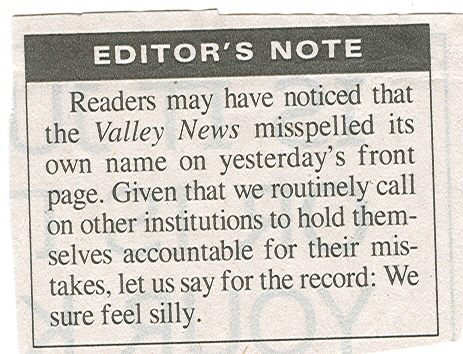
Another error I found was when the newspaper Valley News printed its own name incorrectly. A UK newspaper, Telegraph, wrote about it in their article "Newspaper misspells its own name on front page".

Claire Theobald made an excellent comparison when she wrote in her blog entry that, “[a] good carpenter is one who measures twice before cutting once. So too is a good journalist one who checks and double checks before printing information as fact.” This is a critical rule of thumb in journalism.

Note
Image Source: tonystarkz.com

External Links (also in copy)
New York Times blog post error
Telegraph UK article

Internal Links (also in copy)
Claire Theobald's blog entry

Editing Detective, Kevin Penny

Editing is a skill much like writing and drawing: the more you practise, the better you become. Without editors, we would have top-notch news companies looking like high-school productions. It is imperative to learn a skill such as editing, because if you do not have this skill, then your work can go from looking professional to pathetic with the misplacement of a vowel. For instance:

The Journal shows shoddy editing with a missing 'said' in a lead article

This blurb, taken from the Edmonton Journal, shows that even professional news companies have trouble keeping their articles error free. Granted, this error probably would have been caught before going out into a printed article, but this just shows how different editing for the web can be compared to editing for print; because of the vast amount of content you can place up on the web, it becomes increasingly difficult to make sure every article is perfect.

As said before, great editing comes with lots of practise. A person beginning to learn the skill of editing must understand that no piece of work can be edited to perfection, but hard work and effort can make a difference between reading a professional article or a high-school flyer.

Editing Detective, Jayme Hagen

Errors can be found in even the most prestigious of places. The Accuracy Project takes a look into the World Almanac and Books of Facts. Many of the errors found in the World Almanac have to do with people's dates of birth. It is important to always fact-check to ensure the information you are reporting is accurate. There is no excuse for a misspelled name or a date of birth error.

Continuity errors


The website HorrorKing.com exists solely to point out continuity or factual errors found in horror genre books.

"In Chapter 8, subchapter 2, it says that Thad put the papers on which he had written "The Sparrows Are Flying Again" into one of the desk drawers. But later in Chapter 10, subchapter 2, when Thad shows Liz what he had written, it says that the papers were lying on top of his typewriter."

The internet allows for many critical readers to point out mistakes so it is vital to keep your credibility as a writer that you limit the amount of errors you make; people will write about it.

Blog Errors

Errors can be found on personal blogs:

Perhaps the author should have followed his own advice and proofread his copy.

There are no fact-checkers or proofreaders on blogs, so it is important you do these things yourself.


Bible Errors

There are many contradictions found throughout the Bible.


There are also many factual errors found throughout the Bible's pages.


Considering this was written that many years ago, I have a feeling that they had looser fact-checking requirements. Perhaps an updated version is needed.

Image from American Digest.

Editing Detective, Jesse Snyder


Learning from Errors


Every major newspaper or wire service makes grammatical errors in its publications. It is important for sprouting journalists to recognize this, and analyze these mistakes in order to learn from them. There are many different variables that cause error in a reporter's writing, and recognizing them is the best way for beginners to learn. What's better than learning from another writer's mistakes?

Jennifer Carbert wrote the following in her blog post: "
With all the different possibilities for numbers in a accuracy, not only in recording the right numbers, but in the wording the writer uses to give meaning and context, is vitally important." Before we learn from previous mistakes we must recognize that there is an endless number of variables that can cause inaccuracy or error. Journalists must learn from other writer's mistakes as well as their own, all the while remembering that perfection is impossible.


Errors in Major Newspapers


This is a clip from the Edmonton Journal article "Call off the war against boys." It should say like to be known rather than like to known. These types of errors are typically the most obvious in newspapers. Simply leaving out adjectives and verbs is seemingly one of the most common mistakes made in publications.


This article in the Vancouver Su
n mentioned the the dilemma of how much time and money to spend on one's home. The word dilemma, by definition, is a choice between two or more possibilities. Using how much with the noun dilemma is improper in this sentence. In order to use this word correctly there should be a definite choice for the subject, like a specific amount of time or money to spend on the home.


This is the headline from an Edmonton sun article. It is
inaccurate because the dog was stabbed, not shot. It was an Edmonton police officer, Const. Bruce Edwards, who shot the man. The rest of the article is accurate, so this is a spelling error, not a factual error. This error typifies a common mistake journalists make. It is a single word that was misused, but it still has the potential to change the outlook of the entire story.

Note: Image from a newspaper clipping on mortgage reports website

Sunday, April 11, 2010

Editing Detective, Shannon Findlay


Every day newspapers get filled with the latest information. Every twenty-four hours they are updated and fed to the public, and every day a newspaper will run an apology correcting the mistakes made in previous prints. This system of error and reprint has been around since the beginning of news delivery, yet for the most part it goes unnoticed. A reader does not pick up today's paper wanting to know what was wrong with yesterdays. Any time they spend reading will be to get the quick update on the latest news. Unless a story is ongoing, people may not even remember what they read the day before or question that it may have been inaccurate.

On March 20, 2010 The National Post ran an error correction. In it they apologized for incorrectly saying James Elliott Coyne, a former governor of the Bank of Canada, was dead when in fact he is alive and well. To say someone is dead is a pretty serious accusation and should be checked out carefully before printing such information. Finding out whether someone is still alive should be an extremely easy task, yet it seems to have been overlooked. As a result of such a slip, the reprint ran, but for who's eyes? A small correction is likely to go unnoticed and the damage done by the columnist's error will be solidified.

In an issue of the Sun, a story ran that wrongly described the antics of Nancy Jones at the funeral of her father, Keith Floyd. It described her as being insensitive and having to get escorted out. According to the reprint, Jones was welcomed at the event and was not ushered out because of her behaviour or otherwise. It is incredible that information printed as a fact could be written so wrongly out of proportion. A woman was painted in a very poor light because someone had made his or her own inferences on an event without checking what was real. Not only does this reflect badly on the paper, but also on Nancy Jones. People's reputations can be ruined by what a publication prints about them, whether it's true or not. This should be a thought taken into account every time derogatory stories deride a person's character.

As Jennifer Carbert said in her blog post, "Let each story, caption and picture reflect an attitude of self-respect and honour." Not just honour for those in the story and captions, but honour for the writer. When the time is taken to check the facts, spelling, and grammar there will be much less regrets and far less apologies that go unnoticed.
*note: image from regrettheerror.com

Thursday, April 8, 2010

E-Portfollio - Editing Detective

The trouble with typos is that it is so easy to make them, and what is worse is that once the mistake is made it can be harder for a proofreader to pick them up. The proofreader has to be on the ball in order to find mistakes like the one in the picture. If there had been actual thorough proofreading the word 'dollars' would not have been spelled 'dallors.'

As bad as missing a mistake like that is, it is even worse in the news room. Inaccuracy causes confusion; nothing good ever comes of it. An example of this is from a recent Intercamp article where a quote should have received more attention: “'I think they realized their decision was potentially short-sighted and wasn’t planned out,' said Holmgren." The problem is that Holmgren was not introduced before the quote was used. This means that the reader has no clue who Holmgren is, let alone Holmgren's gender. This was not the only mistake in this article: "MacEwan will use funds from reserves to fund operations of the aquatics facility until June 30, 2011. Money from MacEwan’s reserve fund will be used to keep the pool open until June 2011." These sentences both appeared one right after the other, and they both mean the exact same thing. The reporter repeats the fact right after it was just stated in almost the exact same wording. This could have been avoided. It's just like Katrine wrote: "Both the journalist and the editor carry a great responsibility on their shoulders when it comes to editing work for their newspaper."